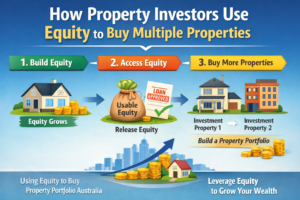
How to Invest in Property Australia Step by Step Guide for Beginners and Experienced Buyers
Investing in property in Australia involves understanding your borrowing capacity, saving at least 10–20% deposit plus purchase costs, researching high-growth locations with strong rental demand, and executing a buy-and-hold strategy focused on long-term capital appreciation.
If you're thinking about building wealth through property, you're not alone. The value of standard Australian homes tripled in many townships over the 20 years ending 2025, making property one of the most reliable wealth-creation vehicles for everyday Australians.
But knowing where to start, how much you need, and which locations offer genuine growth can feel overwhelming. This guide breaks down exactly how to invest in property in Australia, from calculating your borrowing power to choosing the right strategy and avoiding costly mistakes.
Understanding Your Borrowing Capacity Before You Start
Before you even look at a single property, you need to know how much you can borrow. Your borrowing capacity determines which price range you can realistically target.
What Lenders Look at When Assessing Your Loan
Lenders assess multiple factors when determining how much they'll lend you. Your gross income is the starting point, but they also examine your existing debts, living expenses, and credit history.
In 2026, most lenders apply a serviceability buffer of approximately 3% above your actual interest rate. This means if you're quoted 6.5%, the bank tests whether you could still afford repayments at 9.5%.
How Much Can You Actually Borrow
As a rough guide, someone earning $150,000 per year could potentially borrow around $800,000 to $1 million for an investment property, depending on their debts and expenses.
The bigger your deposit, the more you may be able to borrow. But remember that borrowing power isn't just about cash. It's also about demonstrating stable income and responsible financial behaviour over time.
The Impact of Interest Rates on Borrowing
Each 0.25% cut in variable mortgage rates adds around $11,000 to how much an average earner can borrow. But rising inflation and the RBA's February 2026 rate increase to 3.85% have compressed borrowing capacity for many buyers.
First-home buyers are feeling the squeeze most. Higher borrowing costs mean reduced serviceability, which directly impacts how much Australians can borrow.
Deposit Requirements for Investment Property in 2026
The deposit is often the biggest barrier to property ownership. Understanding exactly what you need can help you plan realistically.
Standard 20% Deposit Plus Purchase Costs
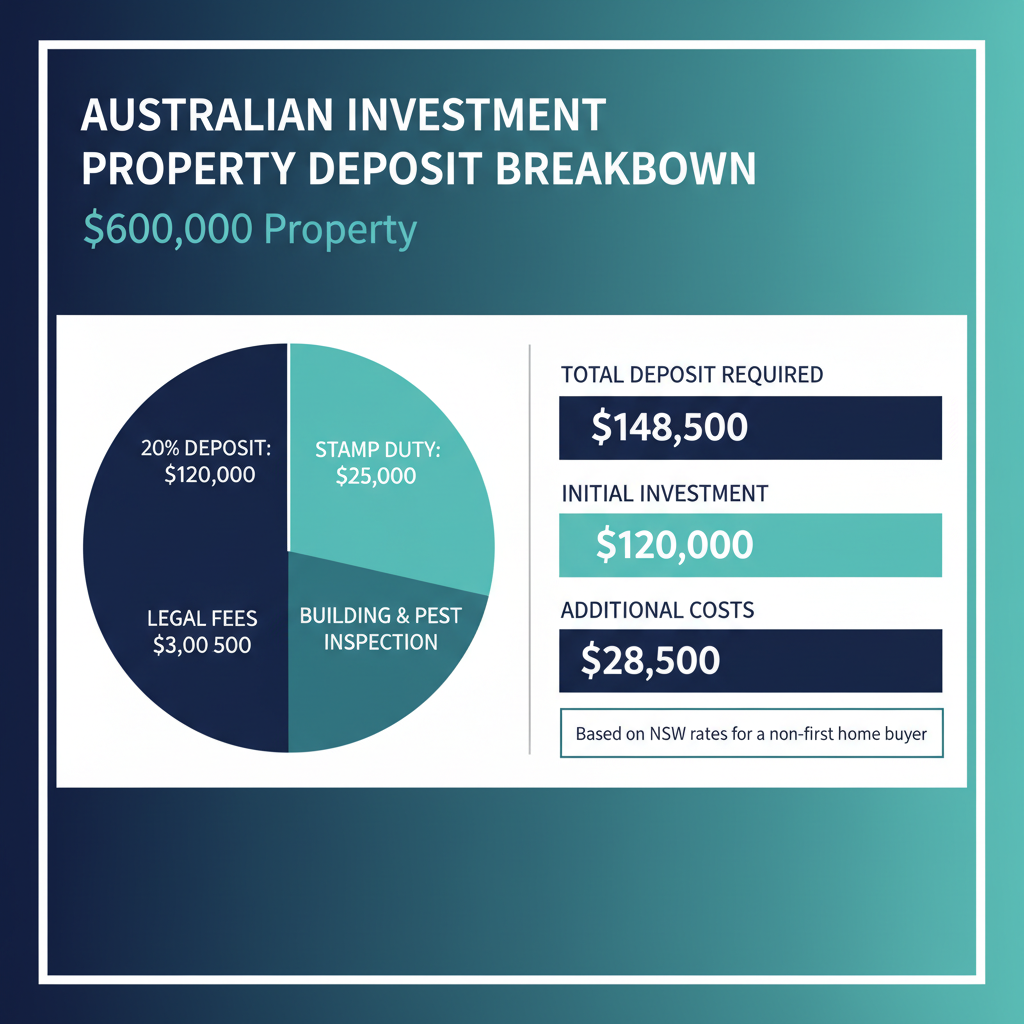
For most investors in 2026, the standard deposit requirement is 20% of the property's purchase price. This keeps your loan-to-value ratio (LVR) at 80%, avoiding Lenders Mortgage Insurance (LMI).
For a $600,000 investment property, you'd need $120,000 as a deposit, plus roughly $25,000 to $30,000 in additional costs like stamp duty, legal fees, and building inspections.
At Buyers Agency Australia, clients typically have approximately $100,000 in savings or usable equity to cover the deposit and all associated costs when purchasing their first investment property.
Lower Deposit Options and LMI Costs
Some lenders will approve investment property loans with deposits as low as 10%, though this requires exceptional serviceability and a strong credit profile. You'll also need to pay LMI, which can add $10,000 to $15,000 for a $600,000 property with a 10% deposit.
While the deposit is half that of the 20% option, the total capital required (deposit plus LMI) is still substantial. Many investors choose this path to enter the market faster and experience capital growth sooner, rather than waiting years to save a larger deposit.
Using Equity from Your Existing Home
If you already own property, you can use your available equity as a deposit for an investment property. Lenders typically allow you to access up to 80% of your property's value minus your remaining loan.
This strategy enables portfolio growth without needing to save additional cash. It's how many experienced investors scale from one property to five or more over time.
Choosing the Right Location Critical for Investment Success

Location determines whether your investment thrives or struggles. In 2026, Australian property markets are fragmented, with some cities and suburbs far outperforming others.
Capital Cities vs Regional Markets in 2026
Perth, Adelaide, and Brisbane are expected to outperform Sydney and Melbourne in 2026. Regional dwelling values rose 9.7% in 2025, compared to 8.2% across combined capital cities, according to recent market data.
Western Australia stood out with a 16.1% annual increase, followed by regional Queensland at 12.6%. But not all regional markets are equal. Focus on larger hubs supported by health, education, logistics, and infrastructure investment.
Sydney and Melbourne are experiencing patchy performance. Poor affordability is biting in Sydney, while Victoria's economic challenges are impacting Melbourne's growth. Well-located properties in gentrifying inner and middle-ring suburbs are still outperforming, but the days of broad-based capital city growth are over.
What Makes a Suburb a Smart Investment
Smart investors look for suburbs where locals' income is growing faster than the national average. Higher disposable incomes mean residents can and will pay a premium to live in these locations.
Key indicators include strong infrastructure (new transport links, schools, retail centres), tight rental markets with low vacancy rates, and limited new housing supply relative to population growth. Suburbs like Williams Landing, Frankston, and Spalding are delivering strong yields and capital growth momentum in 2026.
Avoid suburbs with excessive new developments coming online. Oversupply can soften capital growth and compress rental yields, even in otherwise strong markets.
How to Research Property Markets Properly
Use data from authoritative sources like CoreLogic, SQM Research, and Domain. Look at median prices, rental yields, vacancy rates, and days on market.
But data alone isn't enough. You need boots on the ground. Drive through suburbs, talk to local agents, and understand the demographics. Are young families moving in? Are there new cafés and shops opening? These are real signs of gentrification and long-term growth.
Working with a buyers agent who specialises in investment property can save you months of research and help you avoid expensive mistakes.
Property Investment Strategies That Actually Work
There's no single "correct" strategy. What works depends on your financial position, goals, and risk tolerance.
Buy and Hold for Long Term Capital Growth
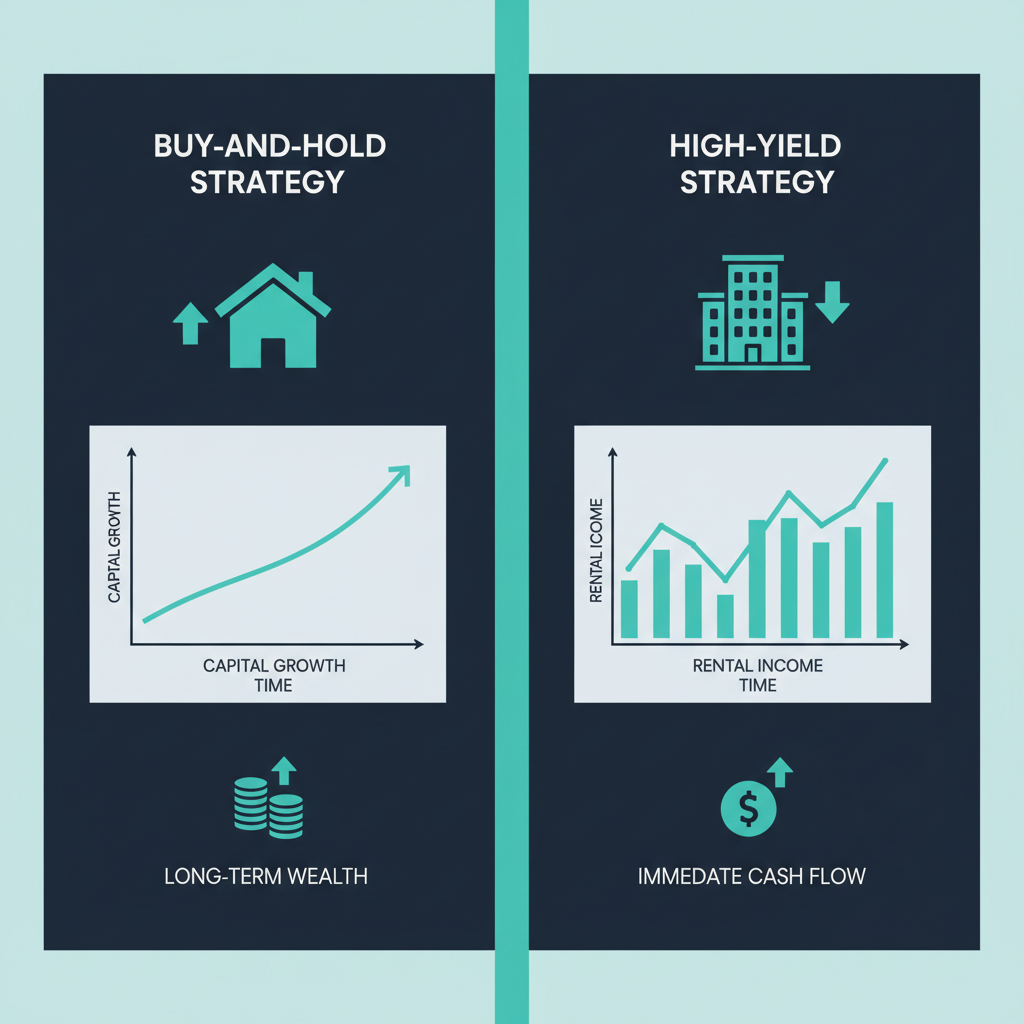
Buy-and-hold is the most common and reliable strategy for Australian investors. You purchase a property in a high-growth location, rent it out, and hold it for 7 to 15 years while it appreciates.
This strategy relies on property values increasing faster than your holding costs. Over a full property cycle, capital growth drives most of your total return, even if yields are moderate.
The key is selecting properties in suburbs with strong fundamentals such as infrastructure, population growth, and limited supply. Buyers Agency Australia helps investors identify these high-growth locations using data-driven 10-year portfolio modelling.
High Yield Properties for Cash Flow
High-yield properties generate strong rental income relative to purchase price. Yields of 5% to 6% are common in regional markets like Geraldton, Port Lincoln, and Spalding.
Cash flow strategies work well for investors who need to cover mortgage repayments from rental income. But remember that high yields often come with lower capital growth. You're trading immediate income for long-term appreciation.
A balanced approach works best. Holding a mix of yield-driven and growth-driven properties allows you to cover short-term cash flow needs while building long-term equity.
Manufactured Growth Through Renovation and Development
Manufactured growth involves adding value through renovations, subdivisions, or small-scale development. This strategy can accelerate equity build-up but requires more time, skill, and risk management.
Successful renovators buy below market value, renovate strategically, and either hold or sell for a profit. But in 2026's competitive market, finding genuinely undervalued properties is harder than ever.
This strategy suits experienced investors who understand construction costs, council regulations, and local demand. Beginners should focus on buy-and-hold first.
The Power of Off Market Properties in 2026
Off-market properties are sold privately before they're listed publicly. They're one of the smartest ways to buy below market value and build equity faster.
Why Off Market Deals Offer Better Value
Sellers choose off-market sales for privacy, speed, or to avoid the stress of public marketing. This creates opportunities for buyers to negotiate without competing against dozens of other bidders.
You're often buying before the property is polished, styled, and marketed to its full potential. This means lower prices and less emotional competition.
How Buyers Agents Access Off Market Properties
Buyers agents have direct relationships with selling agents across multiple markets. They're notified of off-market opportunities before the general public and can move quickly to secure them.
Dragan Dimovski, founder of Buyers Agency Australia, has spent over 20 years building a network that gives his clients first access to off-market deals across Brisbane, Perth, Adelaide, and Sydney.
This isn't about secret listings. It's about relationships, timing, and having a trusted advocate who knows what you're looking for and can act decisively when the right property appears.
Building Equity Faster Through Strategic Purchases
Buying $50,000 below market value instantly creates $50,000 in equity. That equity can be used to fund your next purchase, accelerating portfolio growth without needing to save another deposit.
Off-market properties also tend to perform better over time because they're often in tightly held, high-demand suburbs where sellers don't need to advertise publicly.
If you're serious about building wealth through property, off-market access is a genuine competitive advantage.
Understanding Negative Gearing and Tax Benefits
Negative gearing is Australia's most widely used property tax strategy. It allows investors to claim rental losses as tax deductions, reducing their overall taxable income.
How Negative Gearing Works in Australia
Negative gearing occurs when your rental income is less than your deductible expenses, including loan interest, property management fees, insurance, and maintenance. This creates a net rental loss, which can be offset against your salary or business income.
For example, if you earn $120,000 per year and make a $20,000 loss through negative gearing, you'd be taxed on just $100,000. That reduces your tax payable by around $6,000.
The benefit is greater for higher-income earners. Someone on a 45% marginal tax rate receives a 45% refund on their losses, while someone on 30% receives a 30% refund.
Tax Deductions Available to Property Investors
Investors can claim deductions for loan interest, property management fees, council rates, insurance, repairs and maintenance, and building depreciation. Only expenses directly related to earning rental income are deductible.
Depreciation is particularly valuable. A $600,000 investment property might generate $5,000 to $8,000 in annual depreciation deductions, which don't require any out-of-pocket expense.
Work with a qualified tax advisor or quantity surveyor to maximise your deductions. The ATO scrutinises property investors closely, so accurate record-keeping is essential.
Will Negative Gearing Change in 2026
As of 2026, negative gearing remains unchanged. Both major parties have ruled out reforms, despite ongoing debate about its impact on housing affordability.
Labor proposed restricting negative gearing to new builds in 2016 and 2019 but lost both elections. Any future changes would require federal legislation and likely grandfather existing investments, making the current rules relatively secure for investors.
Common Mistakes Property Investors Make and How to Avoid Them
Most investment mistakes are avoidable. Here's what to watch out for.
Buying in the Wrong Location
Location is everything. Buying in a suburb with oversupply, declining employment, or poor infrastructure will cost you dearly. Don't rely on gut feel or tips from friends.
Use data, visit the area multiple times, and speak to local experts. A buyers agent who specialises in investment property can help you avoid expensive location mistakes.
Overpaying at Auction or Through Emotional Decisions
Auctions are designed to create competition and emotion. Buyers regularly overpay by $20,000 to $50,000 in hot markets.
Set a walk-away price before you bid and stick to it. Better still, work with a buyers agent who can negotiate privately or bid on your behalf without emotional attachment.
Ignoring Cash Flow and Holding Costs
Many investors underestimate holding costs. Loan interest, property management, insurance, maintenance, and vacancy periods all eat into your returns.
Run conservative cash flow projections before you buy. Assume higher interest rates, lower rents, and occasional vacancies. If the numbers don't work under conservative assumptions, walk away.
Failing to Plan for the Long Term
Property investment is a 10 to 20-year game, not a get-rich-quick scheme. Investors who panic and sell during downturns lock in losses and miss the next growth cycle.
Have a clear plan. Know how many properties you want to own, what your target portfolio value is, and how you'll fund each purchase. Review your plan annually and adjust as your circumstances change.
How Buyers Agency Australia Helps Investors Build Wealth Through Property

Investing in property is complex, and getting it wrong is expensive. That's where expert guidance makes all the difference.
Data Driven Investment Strategies and 10 Year Portfolio Modelling
Buyers Agency Australia uses data-driven investment strategies to identify high-growth locations and model long-term portfolio performance. Every recommendation is backed by analysis of infrastructure, demographics, supply constraints, and rental demand.
Dragan Dimovski personally oversees every client strategy, bringing 20+ years of investment experience and a $10 million+ personal portfolio to the table. His approach is grounded in real-world results, not theory.
Clients receive a tailored 10-year portfolio plan that shows exactly how to scale from one property to five or more, building equity and cash flow along the way.
Transparent Fixed Fee Model No Hidden Costs
Unlike commission-based agents who have an incentive to push you toward higher-priced properties, Buyers Agency Australia operates on a transparent, fixed-fee model.
You know exactly what you're paying upfront, and you know your buyers agent is working solely in your interest. No conflicts. No surprises.
Nationwide Coverage Across Brisbane Perth Adelaide and Sydney
While newer to the market compared to veteran agencies, Buyers Agency Australia has rapidly built a presence across all major Australian capital cities. Whether you're targeting high-yield properties in Perth or growth suburbs in Brisbane, the team provides end-to-end support.
From property search and due diligence to negotiation and settlement, Buyers Agency Australia handles the entire process, saving you time and stress while securing better results.
Book a free strategy session to discuss your investment goals and discover how Buyers Agency Australia can help you build long-term wealth through property.
Frequently Asked Questions
How much deposit do I need to invest in property in Australia?
Most investors need a 20% deposit plus $25,000 to $30,000 in purchase costs. Lower deposits (10%) are possible but require LMI.
What is the best property investment strategy for beginners in 2026?
Buy-and-hold in a high-growth suburb with strong rental demand. Focus on capital appreciation over 7 to 15 years.
Are buyers agent fees tax deductible in Australia?
No, buyers agent fees are generally added to the property's cost base and used to calculate capital gains tax when you sell.
Should I invest in capital cities or regional areas in 2026?
Both offer opportunities. Perth, Brisbane, and Adelaide are outperforming Sydney and Melbourne. Regional markets like Geraldton and Port Lincoln offer high yields and affordability.
How does negative gearing work for property investors?
Negative gearing allows you to claim rental losses as tax deductions, reducing your overall taxable income. It benefits higher-income earners most.
Ready to Start Your Property Investment Journey
Investing in property in Australia is one of the most proven paths to long-term wealth. But success requires careful planning, disciplined execution, and expert guidance.
Understand your borrowing capacity, save a realistic deposit, research locations thoroughly, and choose a strategy that matches your goals. Avoid common mistakes by working with professionals who have your best interests at heart.
Buyers Agency Australia specialises in helping investors build wealth through property. With over 20 years of experience, a transparent fixed-fee model, and access to off-market deals across Brisbane, Perth, Adelaide, and Sydney, Dragan Dimovski and his team are positioned to help you achieve your investment goals.
Don't wait for the "perfect" market conditions. The best time to start is now. Book a free strategy session with Buyers Agency Australia and take the first step toward financial freedom through property investment.