
Property equity is the difference between your property's market value and what you owe on your mortgage. Australian investors use this equity as a deposit to purchase additional investment properties without saving cash again, allowing them to build wealth through multiple properties over time.
If you're like most Australians who've owned a property for a few years, you've likely built up equity without even realising it. Property values across Brisbane, Perth, and Adelaide have increased by roughly 90 percent over the last five years.
That growth isn't just a number on paper. It's usable capital that can fund your next investment property.
Understanding how to access and deploy equity is one of the most powerful wealth-building tools available to Australian property investors. For time-poor professionals and first-time investors, working with specialists like Buyers Agency Australia can help you identify high-growth opportunities and structure your equity strategy correctly from the start.
What Is Property Equity and Why Does It Matter
Equity represents the portion of your property that you truly own. It's calculated by subtracting your outstanding mortgage balance from your property's current market value.
For example, if your home is valued at $750,000 and you owe $450,000 on your mortgage, you have $300,000 in total equity.
How Equity Grows Over Time
Equity increases in two primary ways. First, every mortgage repayment reduces your loan balance, automatically increasing your ownership stake.
Second, capital growth adds to your equity when property values rise. In markets like Brisbane and Perth, which recorded 12 percent and 13 percent growth respectively in 2025, equity can accumulate rapidly without any extra effort from the owner.
For investors, this compounding effect becomes the foundation of portfolio expansion. Unlike cash savings that sit idle, equity continues working for you through market appreciation.
Why Equity Matters for Investors
Equity is more than a financial metric. It's a strategic asset that determines your capacity to scale your property portfolio.
Most Australian lenders will allow you to borrow against your equity to fund additional investments. This means you can purchase a second or third property without starting from scratch with deposit savings.
The longer you hold investment-grade properties in strong locations, the more equity you accumulate. Over a 20-year period, assuming an average annual growth rate of 6 percent, a property purchased today for $750,000 could be worth $2.4 million.
Understanding Usable Equity vs Total Equity
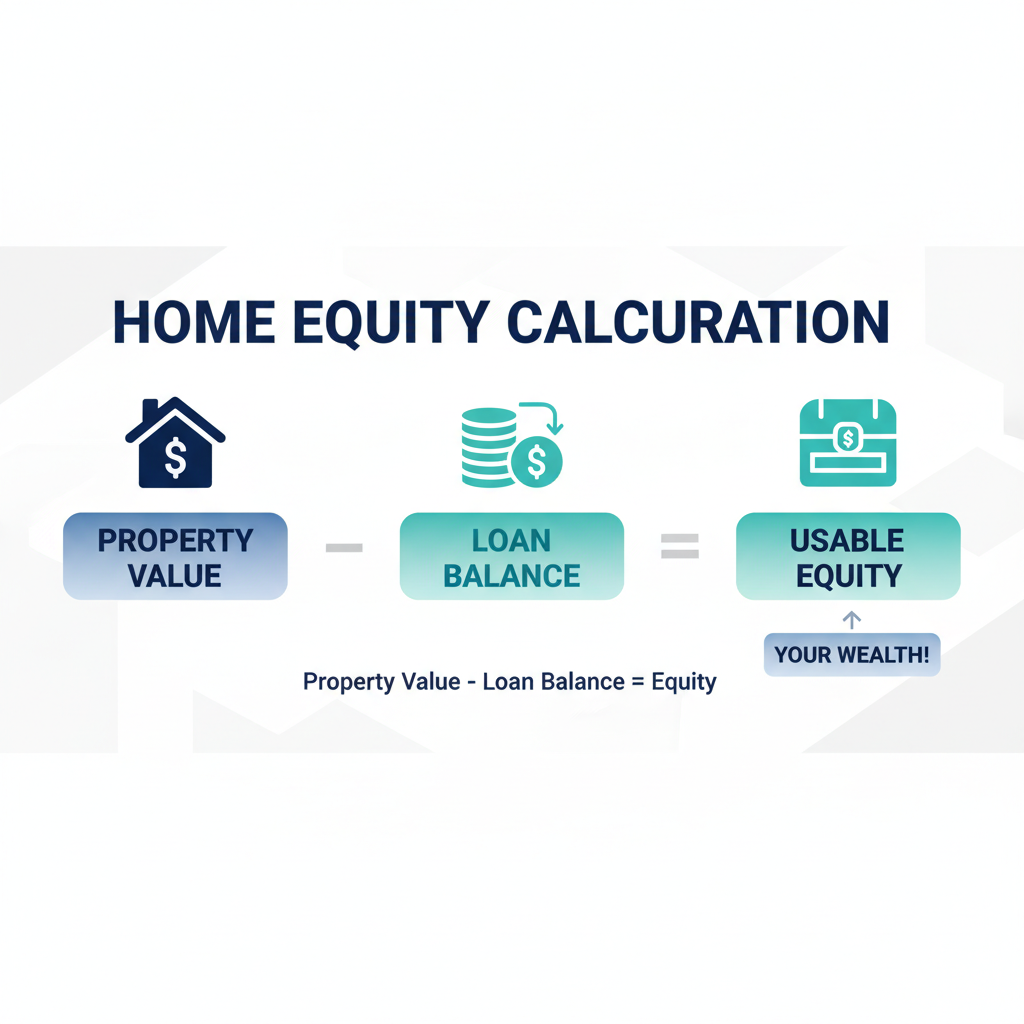
Not all equity is accessible. While you might have substantial equity on paper, lenders will only allow you to borrow a portion of it.
This accessible amount is known as usable equity, and it's governed by strict lending rules designed to protect both you and the bank.
The 80 Percent LVR Threshold
Australian lenders typically cap borrowing at 80 percent of a property's value. This ratio is called the Loan-to-Value Ratio, or LVR.
Staying at or below 80 percent LVR allows you to avoid Lenders Mortgage Insurance (LMI), which can cost tens of thousands of dollars. It also signals to lenders that you're a lower-risk borrower.
The formula for usable equity is straightforward: multiply your property's current value by 0.80, then subtract your outstanding loan balance.
Calculating Your Usable Equity
Let's break this down with a real example. Assume your Brisbane investment property is now valued at $800,000, and you owe $500,000 on the mortgage.
First, calculate 80 percent of the property's value: $800,000 x 0.80 = $640,000.
Next, subtract your outstanding loan: $640,000 – $500,000 = $140,000.
In this scenario, you have $140,000 in usable equity that you could potentially access to fund your next investment.
What Happens Above 80 Percent LVR
Borrowing above the 80 percent threshold is possible, but it triggers additional requirements. You'll likely need to pay LMI, which protects the lender if you default.
Interest rates may also be higher for loans with LVRs above 80 percent. Lenders view these applications as higher risk, and pricing reflects that.
For most investors, staying within the 80 percent LVR range is the smarter long-term strategy. It preserves cash flow, avoids unnecessary insurance costs, and maintains flexibility for future purchases.
How Investors Use Equity as a Deposit for Another Property
Once you've calculated your usable equity, the next step is understanding how to deploy it. Most investors use equity to cover the deposit and purchasing costs of their next investment property.
This approach allows you to grow your portfolio without waiting years to save another 20 percent deposit.
The Rule of Four
A quick estimation tool used by investors is the Rule of Four. Simply multiply your usable equity by four to estimate the maximum purchase price of your next property.
For example, if you have $100,000 in usable equity, you could potentially target properties up to $400,000. This calculation assumes a 20 percent deposit, leaving room for stamp duty and other upfront costs.
While this rule provides a helpful starting point, your actual borrowing capacity depends on income, expenses, existing debts, and lender serviceability requirements.
Accessing Your Equity
There are several methods to access equity. The most common is refinancing your existing loan to release funds.
With a cash-out refinance, your lender increases your loan limit based on your property's current value. The released equity is deposited into your account and can be used as a deposit for the next property.
Another option is a home loan top-up, where you increase your current mortgage limit without switching lenders. This is often faster and involves less paperwork.
Some investors use a line of credit secured against their property. This functions like a revolving credit facility, allowing you to draw funds as needed. Interest is charged only on the amount drawn, not the full limit.
Structuring Multiple Loans
As your portfolio grows, loan structure becomes critical. Many investors separate their loans by property to maintain clarity and flexibility.
For example, you might have one loan for your primary residence and separate loans for each investment property. This approach makes it easier to track deductions, manage cash flow, and refinance individual properties without affecting others.
Cross-collateralisation, where multiple properties secure a single loan, can simplify administration but limits your flexibility. If you need to sell one property, the lender may require you to refinance the entire structure.
Working with a mortgage broker or buyer's agent can help you design a loan structure that aligns with your long-term goals.
Real Example of Equity Release in Action
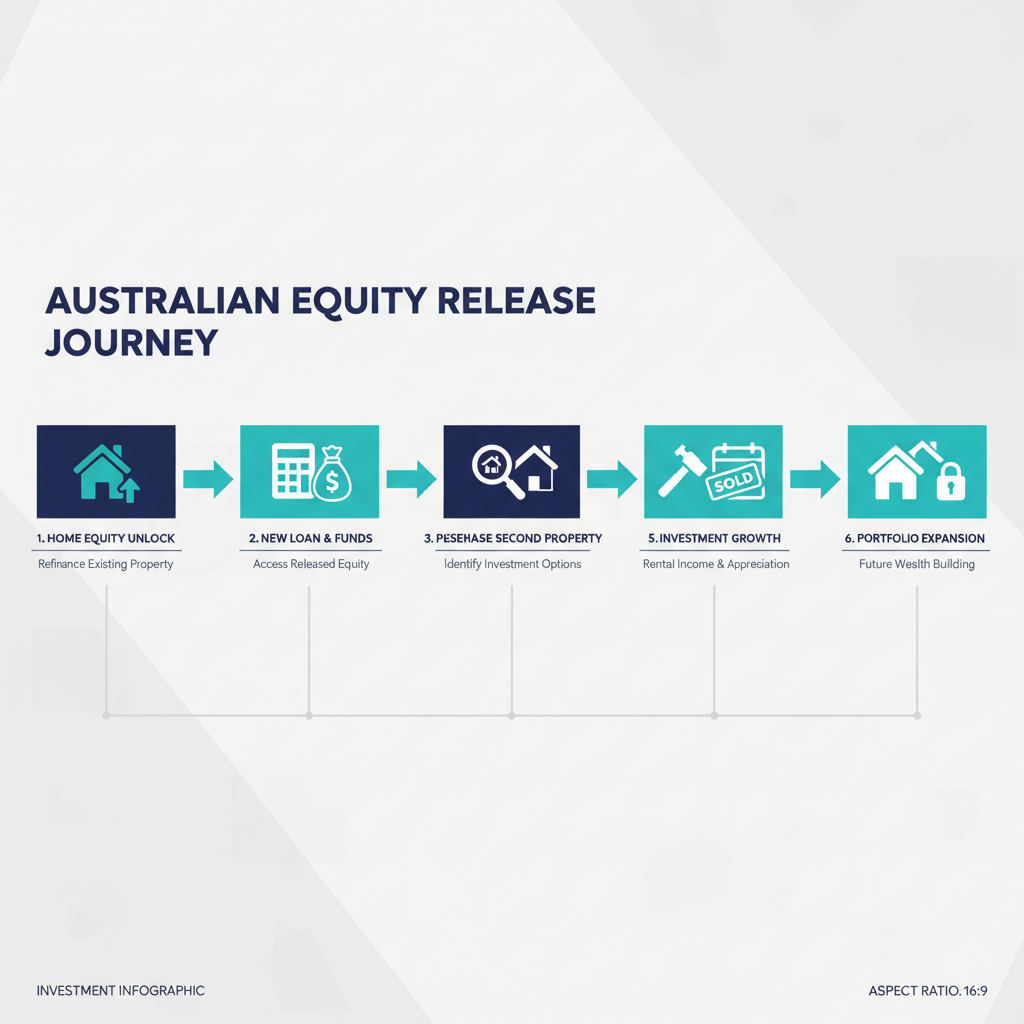
Let's walk through a realistic scenario that shows how equity release works in practice.
Imagine you purchased an investment property in Brisbane in 2021 for $600,000. You borrowed $480,000 at an 80 percent LVR, contributing a $120,000 deposit.
Fast forward to 2026. Brisbane property values have increased by approximately 12 percent annually over this period. Your property is now valued at $750,000.
Calculating the New Equity Position
Your original loan was $480,000. Assuming you've made principal and interest repayments over five years, your loan balance might now be around $450,000.
Your total equity is $750,000 (current value) minus $450,000 (loan balance) = $300,000.
To calculate usable equity, multiply the current value by 0.80: $750,000 x 0.80 = $600,000.
Subtract your outstanding loan: $600,000 – $450,000 = $150,000 in usable equity.
You now have $150,000 available to use as a deposit for another investment property.
Buying the Second Property
Using the Rule of Four, you could target properties up to $600,000 ($150,000 x 4).
You refinance your Brisbane property, releasing $120,000 in equity. This covers a 20 percent deposit on a $600,000 property, plus around $30,000 for stamp duty, legal fees, and building inspections.
You secure a new loan of $480,000 for the second property. You now own two properties with a combined value of $1,350,000, supported by two separate loans totalling $930,000.
Your total equity across both properties is $420,000, and both properties continue to generate rental income and capital growth.
How Investors Repeat This Process to Build a Portfolio
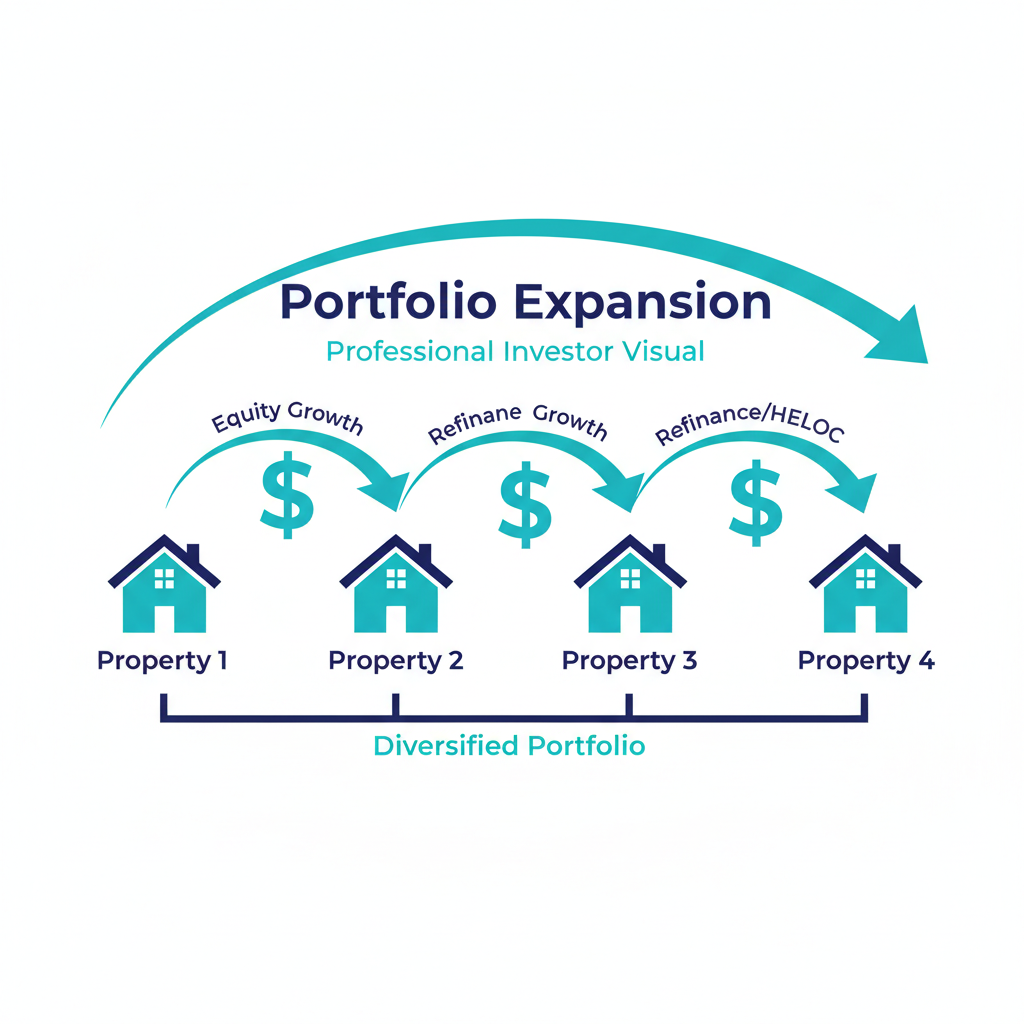
The real power of equity becomes apparent when you repeat this process over time. As your properties appreciate in value and your loans are paid down, your equity continues to grow.
Many successful investors use a systematic approach, purchasing one property every two to three years. This cadence allows each property to accumulate sufficient equity before leveraging it for the next purchase.
Compounding Equity Across Multiple Properties
Let's assume you own two properties, each valued at $750,000, with loan balances of $450,000 each.
Your combined equity is $600,000 ($300,000 per property). Using the 80 percent LVR rule, your usable equity across both properties is $300,000.
This amount could fund the deposit and costs for a third property worth up to $1.2 million, significantly accelerating your portfolio growth.
As each property continues to appreciate, your equity pool expands exponentially. This compounding effect is why long-term investors often own five, ten, or even twenty properties.
The Importance of Serviceability
While equity is essential, it's not the only factor lenders consider. Serviceability refers to your ability to meet loan repayments based on your income, expenses, and existing debts.
Even if you have substantial equity, lenders will stress-test your application by adding a buffer of 2 to 3 percent above current interest rates. This ensures you can still afford repayments if rates rise.
Maintaining strong employment, minimising unnecessary debts, and ensuring positive or neutral cash flow on your investment properties all improve your serviceability.
Timing and Market Selection
Not all properties are created equal. Successful portfolio builders focus on investment-grade properties in high-demand locations with strong long-term fundamentals.
Buying at the right point in the property cycle is crucial. Markets like Perth, Brisbane, and Adelaide have shown strong growth in recent years, but timing and location within those cities still matter.
Working with a buyer's agent who understands market cycles, rental demand, and infrastructure planning can significantly improve your investment outcomes. Buyers Agency Australia offers free strategy sessions to help investors identify the right markets and properties for their goals.
Risks and Considerations When Using Equity
While leveraging equity is a powerful strategy, it's not without risks. Understanding these risks and planning accordingly is essential for long-term success.
Increased Debt and Cash Flow Pressure
Using equity means taking on additional debt. You'll be responsible for repayments on multiple loans, even during periods of vacancy or when interest rates rise.
Maintaining a cash buffer of at least three to six months' worth of repayments is critical. This buffer protects you against unexpected costs like repairs, vacancies, or income disruptions.
Many investors structure their loans with interest-only repayments during the growth phase to improve cash flow. This approach frees up capital for further investments but requires disciplined financial management.
Market Volatility and Negative Equity
If property values decline, you could find yourself in a negative equity position, where your outstanding loan exceeds the property's current value.
This scenario is rare in Australia's major capital cities over the long term, but it can occur during short-term market corrections. Buying investment-grade properties in established, high-demand locations reduces this risk.
Diversifying your portfolio across different cities and property types also helps mitigate market volatility. If one market stagnates, growth in another can offset the impact.
Serviceability Limits
As you acquire more properties, lenders will scrutinise your income and expenses more closely. At some point, you may hit a serviceability ceiling where lenders are unwilling to approve further loans.
Strategies to improve serviceability include increasing your income, reducing non-investment debts, restructuring existing loans, and using interest-only periods strategically.
Some investors also structure loans across multiple lenders to maximise borrowing capacity. Each lender has different assessment criteria, so spreading your portfolio can unlock additional capacity.
Tax and Legal Considerations
Investment properties come with tax obligations and benefits. Interest on investment loans is generally tax-deductible, as are property management fees, maintenance costs, and depreciation.
However, capital gains tax applies when you sell an investment property. Planning your exit strategy and holding properties for at least 12 months can reduce your CGT liability through the 50 percent discount.
Consulting with a qualified accountant and property lawyer ensures your structure is tax-efficient and legally sound.
How Buyers Agency Australia Helps Investors Maximise Equity

Building a multi-property portfolio requires more than just equity. It demands strategic planning, market knowledge, and disciplined execution.
Buyers Agency Australia specialises in helping investors identify high-growth, cash-flow-positive properties that accelerate equity accumulation. With over 20 years of experience and a $10M+ personal portfolio, founder Dragan Dimovski understands the practical realities of portfolio building.
Data-Driven Property Selection
Buyers Agency Australia uses a transparent, fixed-fee model and relies heavily on 10-year portfolio modeling. This approach ensures every property purchase aligns with your long-term wealth creation goals.
Rather than chasing short-term hotspots, the agency focuses on suburbs with strong rental demand, infrastructure investment, and sustainable growth drivers. These properties generate equity faster and hold their value through market cycles.
End-to-End Support
From initial strategy sessions to property search, due diligence, negotiation, and settlement, Buyers Agency Australia manages the entire process. This is particularly valuable for time-poor professionals who lack the bandwidth to research markets and attend inspections.
The agency also provides ongoing support after settlement, helping clients monitor performance, review loan structures, and identify the right time to leverage equity for their next purchase.
Proven Results
Clients of Buyers Agency Australia have successfully built portfolios of five, ten, or more properties using equity strategies. By focusing on investment-grade assets and timing purchases strategically, these investors have compounded their equity and created substantial passive income streams.
If you're ready to start or scale your property portfolio, book a free strategy session to discuss your goals and map out a personalised equity-release plan.
Frequently Asked Questions
How much equity do I need to buy another investment property?
You typically need at least $100,000 in usable equity to cover a 20 percent deposit and purchasing costs on a median-priced property.
Can I access equity without refinancing my loan?
Yes, through a home loan top-up or a line of credit secured against your property, though refinancing often offers better rates.
What is the 80 percent LVR rule?
Lenders generally allow borrowing up to 80 percent of your property's value to avoid Lenders Mortgage Insurance and reduce risk.
How long should I wait between buying properties?
Most investors wait two to four years to allow sufficient equity to accumulate and ensure serviceability remains strong.
Is using equity risky?
Using equity increases debt and requires strong cash flow management, but it's a proven long-term strategy when combined with quality property selection and financial discipline.
Why Understanding Equity Is Key to Long-Term Wealth
Property equity is one of the most powerful tools available to Australian investors. It allows you to scale your portfolio without saving multiple deposits, accelerates wealth creation through compounding growth, and provides flexibility to respond to market opportunities.
Successful investors treat equity as a strategic resource, not just a financial metric. They understand the difference between total and usable equity, respect the 80 percent LVR threshold, and structure their loans to maximise flexibility and tax efficiency.
Building a property portfolio is a long-term game. It requires patience, discipline, and expert guidance. By partnering with specialists like Buyers Agency Australia, you can avoid costly mistakes, identify high-performing properties, and build a portfolio that delivers genuine financial freedom.
Whether you're buying your first investment property or scaling to your fifth, understanding how to unlock and deploy equity is the difference between average returns and life-changing wealth.
Ready to take the next step? Contact Buyers Agency Australia today to discuss your equity position and create a personalised investment roadmap.