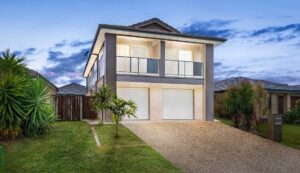
Satellite suburbs within 25-45km of major CBDs are delivering rental yields above 5% and annual capital growth exceeding 10% in 2026, driven by multi-billion dollar infrastructure projects like Western Sydney Airport and Brisbane's Olympic upgrades. These outer-ring 'connector' zones offer beginner investors entry prices $200,000-$400,000 below inner-city equivalents while capturing the same employment and transport benefits within 5-10 years.
The old Australian dream of owning within 10km of the CBD is dead for most first-time investors. Median house prices in Sydney's inner ring now exceed $2.6 million, while Melbourne's established suburbs hover around $1.87 million. But here's the thing: the real money in 2026 isn't in the centre anymore. It's in the connectors.
Satellite suburbs are the outer-ring areas positioned near major infrastructure projects that will reshape how Australians live and work over the next decade. We're talking about places like Marsden Park (25km from Western Sydney Airport), Springwood (20km south-east of Brisbane CBD), and Wellard (40km south of Perth CBD). These aren't fringe speculative plays. They're data-backed growth corridors where smart money is quietly accumulating before the crowd catches on.
What is the Satellite Surge and Why Does It Matter in 2026
The Infrastructure Over Aesthetics Principle
A $10 billion rail project adds more value than a marble kitchen benchtop ever will. That's not opinion. It's observable market behaviour across every Australian capital over the past 30 years.
Western Sydney Airport is opening in late 2026 with a $5.3 billion price tag. The airport will create 28,000 permanent jobs by 2031 and over 200,000 jobs by 2050, according to Deloitte Access Economics. Suburbs within 25km of the airport site have already seen explosive growth. Bringelly median house prices surged from $935,000 to $2.4 million between 2019 and 2025, while Liverpool house prices grew 9.3% annually, outpacing Sydney's 5.7% average.
But the airport is just the anchor. Six new metro stations, upgraded arterial roads, and the $35 billion Aerotropolis plan will create a "30-minute city" model that integrates residential, commercial, and recreational spaces. This isn't a suburb. It's a new economic zone designed to accommodate 250,000 residents by 2050.
The Yield Shield: Why 5%+ Rental Returns Matter Now
Beginner investors in 2026 face a harsh reality: interest rates are holding at 4.35% (RBA cash rate) and aren't expected to drop below 3.5% until late 2027. That means your property needs to generate cash flow to survive the hold period.
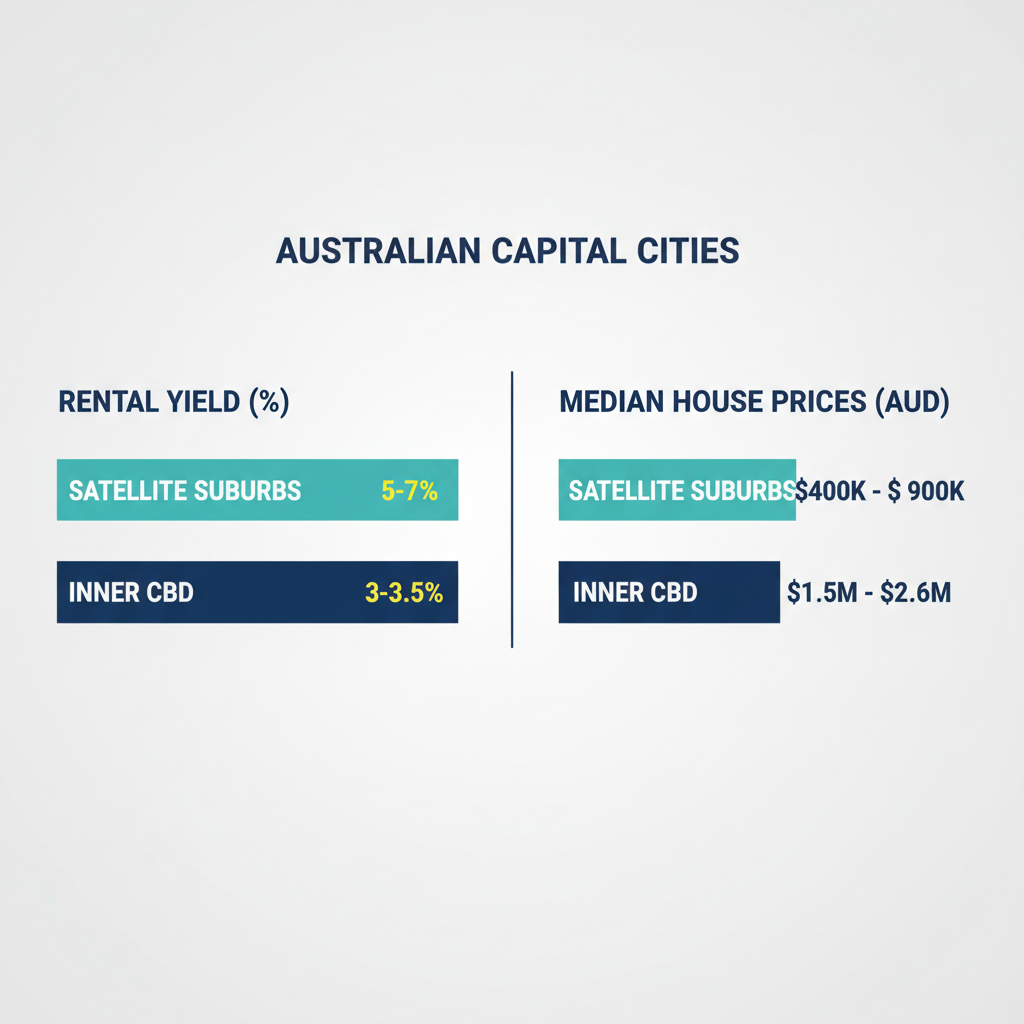
Satellite suburbs offer gross rental yields between 5% and 7% compared to 3-3.5% in established CBD areas. Spalding (regional WA) delivers 5.7% yields on a $395,000 median. Stapylton (outer Brisbane) offers 5.6% on $420,000. Even Marsden Park (Western Sydney) provides 4.8-5.2% yields on houses priced $880,000-$1.26 million.
Here's why that matters: a 5% yield on a $600,000 property generates $30,000 annual rent. After expenses (rates, insurance, maintenance), you're covering most of your mortgage interest. A 3% yield on a $1.2 million inner-city apartment? You're bleeding $15,000-$20,000 a year in negative cash flow. The yield shield isn't just nice to have. It's survival insurance in a high-rate environment.
Social Proof: Where the Smart Money Was Quietly Buying
While headlines obsessed over Perth's 2025 boom (7.5% dwelling value growth), savvy beginners were securing the outer rings of Brisbane, Western Sydney, and Adelaide's northern corridor.
REA's 2026 Hot 100 suburbs list identified Austral and Leppington (Western Sydney) as top picks, driven by rezoning and master-planning. Clyde North and Cranbourne East (Melbourne's south-east) are experiencing rapid population growth with new schools, sports facilities, and master-planned estates. Alkimos, Baldivis, and Ellenbrook (Perth's northern and southern corridors) combine transport upgrades and coastal lifestyle at prices 30-40% below inner Perth.
These suburbs share common traits: proximity to new transport hubs, median prices under $900,000, rental yields above 4.5%, and 10-year infrastructure pipelines already funded. They're not speculative. They're strategic.
The Five Satellite Zones Delivering Right Now
Western Sydney: The Airport Effect Zone
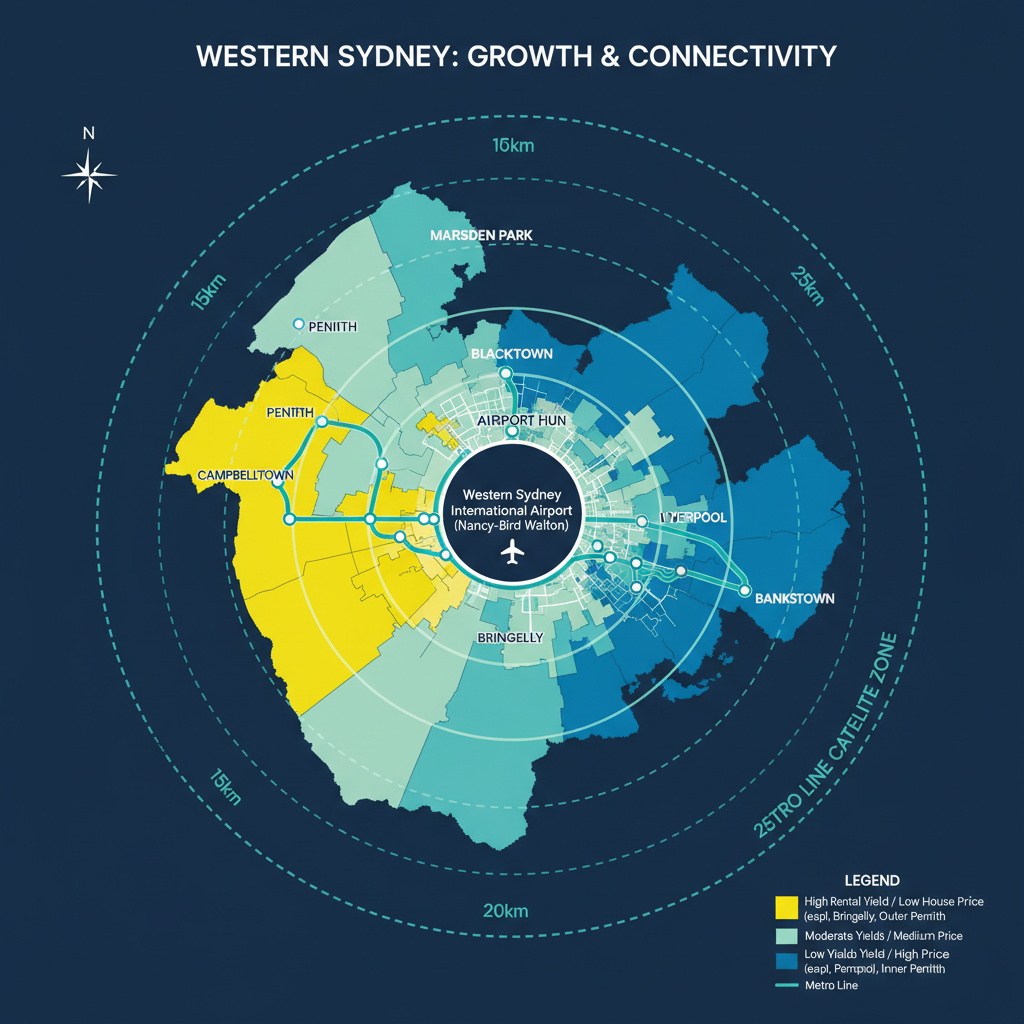
Western Sydney International Airport (Nancy-Bird Walton Airport) is the single largest infrastructure catalyst in Australia right now. The airport opens late 2026, but the surrounding suburbs have been appreciating since construction began in 2018.
Marsden Park (51km north-west of Sydney CBD) sits 25km from the airport. Median house prices reached $1.26 million in early 2025, up from $431,000 in 2019. That's 192.9% growth in 5 years. Gross rental yields hover around 3.5-3.6% ($680/week on a $1.26 million house), which is low compared to regional areas but exceptional for Greater Sydney.
The risk? Supply. Marsden Park is part of a massive land release area. New estates are flooding the market. Buyers need to target homes near future transport hubs (the planned metro extension) and established schools. Generic house-and-land packages 5km from any amenity will underperform.
Penrith (70km west of Sydney CBD, 25km from the airport) offers better affordability at $880,000 median house price. Historical growth averaged 7.4% annually over 5 years, with rental yields between 4.3-4.8%. The suburb benefits from existing rail connectivity (90-minute train to Sydney CBD) and proximity to the airport employment zone. Jordan Springs (sub-precinct of Penrith) recorded 9% growth in 2025 at a $920,000 median. Kingswood (another Penrith sub-precinct) offers $750,000 entry with 8.2% growth and 4.8% yields.
Penrith is a 15-20 year play. If you need results in 3-5 years, look elsewhere. But for patient investors targeting total returns (capital growth + rental income), Penrith offers one of the best risk-adjusted profiles in Greater Sydney.
Brisbane's Olympic Corridor: The 2032 Infrastructure Wave
Brisbane's 2032 Olympics isn't just a two-week event. It's a decade-long infrastructure boom that's reshaping the city's outer suburbs. SQM Research forecasts Brisbane dwelling values will surge 10-15% by 2026, fuelled by population growth and Olympics-related transport upgrades.
Springwood (20km south-east of Brisbane CBD) is the standout. Median house prices reached $982,000 in 2025, up 6% annually. But the real story is units: median unit prices hit $595,000, up 22.7% in 12 months. Rental yields sit at 3.7% for houses ($680/week) and 4.3% for units ($480/week). Days on market? 22 days for houses, 11 days for units. That's strong buyer and tenant demand.
Springwood benefits from easy access to the M1 motorway, public transport, shopping centres, and schools. It's designated a "Principal Activity Centre" in the South East Queensland Regional Plan, meaning long-term government commitment to infrastructure and employment hubs.
Greater Flagstone (south-east QLD) is Australia's biggest growth corridor by design. Planned to accommodate 50,000 new homes and 120,000 population over 30 years, it offers investors affordability ($747,500 median) and near double-digit growth (9.9% annual). Gross rental yields sit at 4.2% ($590/week). The risk? It's a greenfield site. Infrastructure delivery is staged over decades. Early buyers win. Late buyers inherit oversupply.
Perth's Supply-Constrained Boom: The Western Fringe
Perth led Australia's property market in 2025 with 7.5% dwelling value growth and median values reaching $855,267. Vacancy rates hover near 1%, rental yields average 4.8%, and supply remains chronically tight.
Wellard (40km south of Perth CBD) offers affordability at $690,000 median with 8.67% annual growth and 5% rental yields. That's rare: double-digit-adjacent capital growth plus positive cash flow. Bateman (8km south of Perth CBD) delivered 24.27% annual growth in 2025, but the median price ($1.365 million) prices out most beginners.
The Perth fringe play is simple: buy where supply is constrained, rental demand is structural (not cyclical), and transport upgrades are funded. Alkimos, Baldivis, and Ellenbrook all recorded double-digit annual gains in 2025 and sit within 30-40km of Perth CBD. They combine coastal lifestyle, new estates, and relative value compared to inner-Perth suburbs like Cottesloe ($1.4 million+ medians).
Regional WA offers even higher yields. Spalding (Greater Geraldton, 424km north of Perth) recorded 38.6% annual growth with a $395,000 median and 5.7% yields ($460/week rent). Geraldton itself delivered 24.47% annual growth on a $473,000 median. These are resource-exposed towns. They boom and bust. But for investors targeting short-term cash flow and willing to exit within 5-7 years, they're exceptional.
Adelaide's Northern Growth Corridor: The Undersupplied Play
Adelaide remains one of Australia's most balanced markets for investors: steady capital growth, reliable rental returns, and undersupply across metro and regional areas. Vacancy rates often hit 0.4%, the lowest in Australia.
Davoren Park (25km north of Adelaide CBD) recorded 28% house price growth in 2024. Neighbouring suburbs grew 27%. The median remains affordable (sub-$500,000), and yields exceed 5.5%. Adelaide's ultra-low vacancy means yield is safe. Capital growth? It's slower than Perth or Brisbane but more predictable.
Inner and near-city suburbs like Brooklyn Park, Brompton, Ovingham, and Port Adelaide benefit from proximity to the CBD and major renewal projects. They're positioned for long-term gentrification as Adelaide's population grows and affordability pressures spread from Melbourne and Sydney.
Melbourne's Outer Growth Corridors: The Comeback Play
Melbourne was the weakest performer among major capitals in 2025, but KPMG forecasts house prices will rise 6.6% and unit prices 7.1% in 2026, one of the strongest nationwide projections.
Clyde North (south-east growth corridor) offers exceptional affordability and long-term growth potential. Large master-planned communities, new schools, and shopping centres attract young families. Investors see strong demand from first-home buyers and renters, coupled with ongoing infrastructure delivery (upgraded arterial roads and planned rail extensions).
Cranbourne East (neighbouring Clyde North) is one of Australia's fastest-growing population areas, underpinned by large master-planned estates, new schools, and emerging retail hubs. Pakenham (through-running endpoint of the new Metro Tunnel opening February 2026) benefits from direct CBD access. Apartment rents are forecast to rise 24% by 2030 as vacancy drops from 1.8% to 1.1%.
The Melbourne play is contrarian. Prices are still below 2017 peaks in many middle-ring suburbs. Oversupply has been absorbed. Demand is catching up. Outer-growth corridors like Tarneit, Werribee, and Melton offer family homes, solid yields (4.5-5%), and relative affordability within commuting distance of Melbourne CBD.
How to Identify the Next Satellite Surge Suburb Before Prices Spike
The Infrastructure Checklist: What to Look For
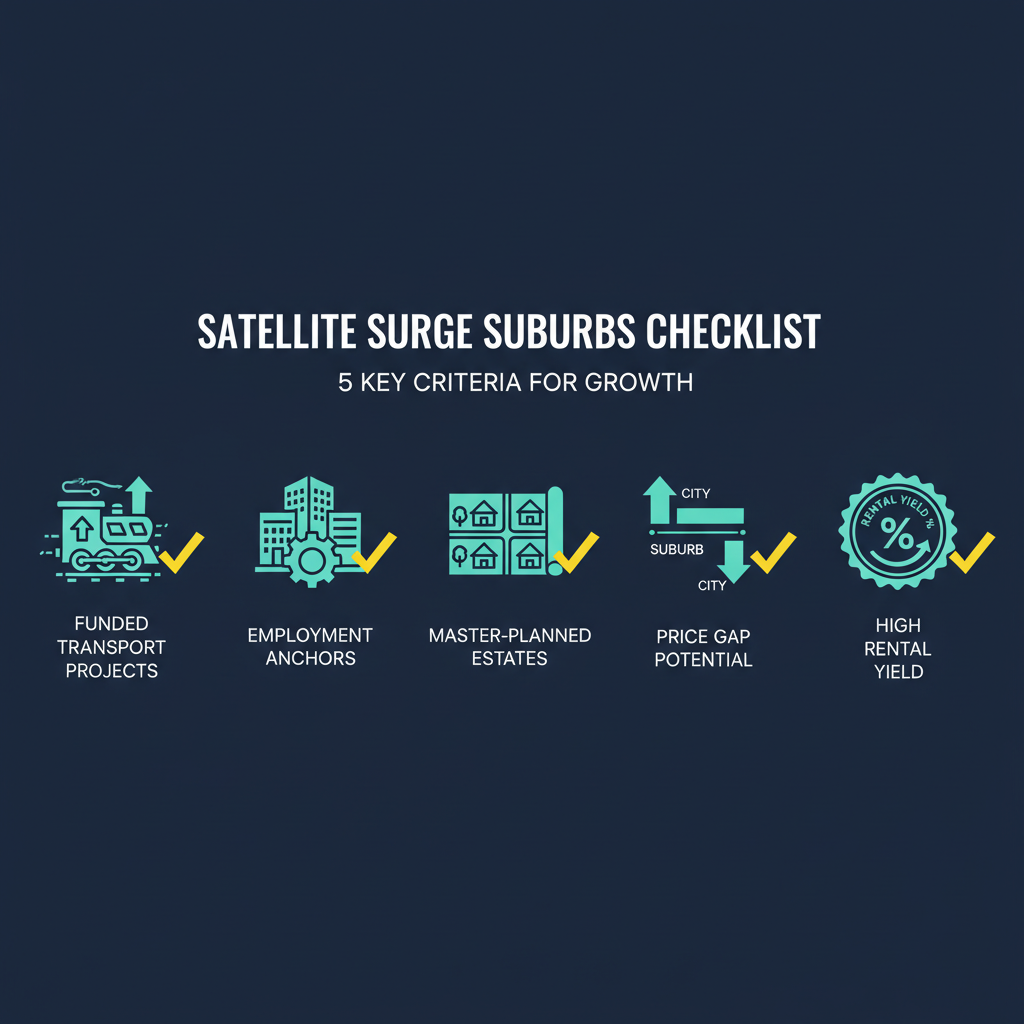
Not all outer suburbs are created equal. Infrastructure pipelines separate winners from losers. Here's the checklist:
- Funded transport projects within 5-10 years: New metro stations, upgraded highways, or rail extensions. Check Infrastructure Australia's Priority List and state government transport plans.
- Employment anchors: Airports, business parks, hospitals, or universities within 15km. These create structural rental demand, not cyclical tourism or mining booms.
- Master-planned estates with staged delivery: Avoid suburbs where 5,000 lots hit the market simultaneously. Look for 10-15 year rollout plans with amenities delivered in stages.
- Median prices $200,000-$400,000 below inner-ring equivalents: This gap narrows as infrastructure delivers. Marsden Park closed the gap from $900,000 in 2019 to near-parity with parts of Greater Western Sydney by 2025.
- Rental yields above 4.5%: This is your insurance policy. If capital growth stalls, rental income covers holding costs.
The Data Sources Every Beginner Investor Should Bookmark
Use CoreLogic's Hedonic Home Value Index for median values and quarterly growth trends. CoreLogic tracks dwelling values by suburb, property type, and price bracket.
SQM Research's Rental Yield Calculator provides gross rental yields by suburb and postcode. Filter by houses vs units and compare across capital cities.
REA's PropTrack Home Price Index publishes quarterly forecasts and annual Property Market Outlook reports. Their 2026 Hot 100 suburbs list is curated by industry experts using PropTrack data.
Infrastructure Australia's Priority List identifies nationally significant infrastructure projects, timelines, and funding status. This is your early-warning system for the next satellite surge zone.
Local council development applications (DAs) reveal upcoming master-planned estates, shopping centres, and transport hubs. Check council websites quarterly. When you see 10+ DAs for townhouses or medium-density housing near a future metro station, that's your signal.
The Timing Question: Is It Too Late for Western Sydney?
The airport opens late 2026. Suburbs within 10km of the airport site (Bringelly, Badgerys Creek, Luddenham) have already priced in 5-10 years of growth. Bringelly went from $935,000 to $2.4 million. That ship has sailed.
But suburbs 20-30km from the airport? They're mid-cycle. Penrith, Liverpool, Campbelltown, and Camden will feel the airport's impact as employment zones mature and transport links improve. The real benefits kick in 2030-2040, not 2026. Patient investors who can hold 10-15 years will capture the full uplift.
The next wave? Look north and west. Rouse Hill, Box Hill, and Schofields sit 35-45km from the airport but benefit from existing metro connectivity (Sydney Metro Northwest line). As Western Sydney urbanises, these middle-ring suburbs will gentrify. Current medians ($1.1-$1.4 million) are still 20-30% below inner-west equivalents.
How Dragan Dimovski and Buyers Agency Australia Navigate the Satellite Surge

Dragan Dimovski has spent 20+ years identifying infrastructure-driven growth corridors before they hit mainstream media. His $10M+ personal portfolio includes multiple satellite suburb holdings acquired during previous cycles: Western Sydney in the early 2010s, Brisbane's outer south-east in 2016-2018, and Perth's northern corridor in 2020-2022.
The Buyers Agency Australia methodology focuses on three pillars: infrastructure over aesthetics, yield-shield protection, and 10-year portfolio modelling. Here's how it works in practice.
The 10-Year Portfolio Modelling Approach
Most beginner investors ask: "What suburb should I buy in?" Dragan flips the question: "What does your portfolio need to look like in 10 years, and what suburbs get you there?"
A typical beginner portfolio might target $500,000 in equity growth over 10 years. That requires holding 2-3 properties in suburbs averaging 6-8% annual capital growth. At 7% compound growth, a $600,000 property reaches $1.18 million in 10 years. That's $580,000 in equity gain. Two properties? You're at $1.16 million in equity.
But that assumes you survive the hold period. High interest rates, cost-of-living pressures, and rental vacancies can force early exits. The yield shield protects you. A 5% gross yield on $600,000 generates $30,000 annual rent. After $8,000 in holding costs (rates, insurance, maintenance), you're netting $22,000. That offsets $22,000 of mortgage interest. On a $480,000 loan (80% LVR) at 6.5% interest, you're paying $31,200 annually. Your out-of-pocket cost? $9,200/year, or $767/month.
Compare that to a 3% yield inner-city apartment. $600,000 property, $18,000 annual rent, $8,000 holding costs, $10,000 net rent. Same $480,000 loan, same $31,200 interest. Your out-of-pocket? $21,200/year, or $1,767/month. That's $12,000 more annual cash burn. Over 10 years? $120,000. Most beginners can't afford that.
Buyers Agency Australia models this upfront. The satellite surge strategy prioritises suburbs where rental income covers 60-80% of holding costs, allowing investors to survive rate cycles and hold long enough to capture capital growth.
The Due Diligence Process: What Gets Rejected
Dragan's team rejects 80% of satellite suburbs due to supply risk, single-industry dependence, or poor transport connectivity. Here are three red flags:
Red Flag 1: Mining-dependent towns with no economic diversification. Moranbah (QLD) offers 10%+ rental yields but relies entirely on coal mining. When commodity prices drop, vacancy rates spike and property values collapse. Dragan's rule: avoid single-industry towns unless you're a sophisticated investor with a 3-5 year exit plan.
Red Flag 2: Greenfield estates 10km+ from any transport hub. Satellite suburbs work when they're connectors. If the suburb is 10km from the nearest train station, 15km from the nearest hospital, and 20km from major employment, it's not a satellite. It's a speculative land bank. Reject.
Red Flag 3: Suburbs with 5+ years of negative capital growth and rising vacancy rates. Some outer suburbs never gentrify. They stay low-socioeconomic, high-crime, and low-demand. Elizabeth North (Adelaide's northern fringe) recorded 28% growth in 2024, but vacancy rates remain elevated and days on market are twice the Adelaide average. Approach with caution.
The FastTrack Event: How Dragan Teaches the Satellite Surge Strategy
Dragan runs quarterly FastTrack Property Investment Events where he breaks down current satellite surge zones, reviews case studies, and walks through live suburb comparisons.
Recent events covered Penrith vs Ipswich (Western Sydney vs Brisbane outer south-west), Alkimos vs Baldivis (Perth northern vs southern corridor), and Cranbourne East vs Pakenham (Melbourne south-east growth corridor).
Attendees receive access to Buyers Agency Australia's proprietary suburb scorecard, which ranks 500+ Australian suburbs on infrastructure pipeline, rental yield, affordability gap, and supply risk. The scorecard updates quarterly based on new transport announcements, council development approvals, and CoreLogic data.
If you're serious about the satellite surge strategy, attending a FastTrack event is the fastest way to compress 5 years of learning into a single day.
The Satellite Surge Risks: What Can Go Wrong
Satellite suburbs aren't risk-free. Here are the three biggest traps and how to avoid them.
Risk 1: Infrastructure Delays and Funding Cuts
Governments delay or cancel projects. Melbourne's East West Link was cancelled in 2014 after $1.1 billion was spent. Suburbs banking on the link (Parkville, Clifton Hill) saw slower growth for 5 years.
Western Sydney Airport is federally funded and construction is 70%+ complete. The risk of cancellation is near zero. But suburban rail extensions (Penrith metro, Leppington upgrades) are state-funded. Budget blowouts can push delivery dates 3-5 years.
Mitigation: Buy suburbs where the anchor infrastructure (airport, hospital, university) is already funded and under construction. Treat suburban rail extensions as bonus upside, not base case.
Risk 2: Oversupply from Concurrent Land Releases
Greenfield estates can flood the market with identical house-and-land packages. Melonba (Western Sydney) has exploded from 3,000 people in 2016 to 7,000 in 2021, with 17,000+ homes planned. Supply risk is high.
When 2,000 lots hit the market simultaneously, developers undercut each other. Prices stagnate. Renters have dozens of identical properties to choose from, pushing vacancy rates up and rents down.
Mitigation: Target suburbs with staged land releases over 10-15 years. Check council DAs for total lot approvals and compare to current dwelling stock. If approved lots exceed current stock by 50%+, supply risk is elevated. Also, buy established homes (5+ years old) rather than house-and-land packages. Established homes near schools and transport hubs outperform cookie-cutter estates.
Risk 3: Demographic Mismatch (Young Families Can't Afford Forever)
Satellite suburbs attract young families priced out of inner suburbs. But affordability constraints are worsening.
Mitigation: Prioritise suburbs where median household incomes are rising faster than city averages. Western Sydney's airport employment zone will create 28,000 high-wage jobs by 2031. That's structural income growth, not just population growth. Target suburbs within 30-minute commutes of these employment zones.
Why 2026 is the Last 'Early' Window for Satellite Suburbs
Western Sydney Airport opens late 2026. Brisbane's Olympics infrastructure accelerates 2026-2032. Perth's supply constraints persist through 2027. Adelaide's northern corridor rezoning is 80% complete.
If you buy in 2026, you're early-to-mid cycle. Prices have risen 20-40% from 2020 lows, but the infrastructure benefits won't fully materialise for 5-10 years. That's the window.
By 2028-2029, media will be covering the "Western Sydney property boom" and "Brisbane's Olympic property surge." Beginner investors will pile in. Prices will spike another 30-50%. Yields will compress. The risk-reward will flip.
Right now, in early 2026, satellite suburbs offer the rare combination of affordability, yield, and infrastructure-backed growth. It's not a get-rich-quick play. It's a 10-15 year wealth-building strategy for investors who understand that infrastructure beats aesthetics, every time.
Frequently Asked Questions
What is a satellite suburb in property investment?
A satellite suburb is an outer-ring area within 25-45km of a major CBD, positioned near significant infrastructure projects like airports, metro lines, or business parks. These suburbs offer lower entry prices than inner-city areas while benefiting from future infrastructure-driven employment and transport connectivity, typically delivering higher rental yields (5%+) and long-term capital growth.
Is it too late to invest in Western Sydney near the airport?
Suburbs within 10km of Western Sydney Airport (Bringelly, Badgerys Creek) have already priced in significant growth, with some medians tripling since 2019. However, suburbs 20-30km away (Penrith, Liverpool, Campbelltown) remain mid-cycle opportunities as employment zones and transport links develop through 2030-2040. Patient investors with 10-15 year hold periods can still capture substantial infrastructure-driven uplift.
What rental yield should beginner investors target in 2026?
Beginner investors should target gross rental yields above 5% in outer suburbs and 4.5%+ in middle-ring satellite areas. This "yield shield" helps cover mortgage interest and holding costs during high interest rate periods, allowing investors to survive the hold period and capture long-term capital growth. Yields below 4% often result in negative cash flow exceeding $1,500/month for most beginners.
Which Australian cities offer the best satellite suburb opportunities in 2026?
Brisbane, Perth, and Western Sydney offer the strongest satellite suburb opportunities in 2026. Brisbane benefits from Olympics infrastructure and population growth (10-15% forecast price growth). Perth delivers the highest yields (4.8-6%) with chronic supply constraints. Western Sydney provides the largest long-term infrastructure catalyst (airport + Aerotropolis), though early-stage suburbs have already appreciated significantly. Melbourne's outer corridors are mid-recovery with forecast 6.6% house price growth.
How do I identify oversupply risk in satellite suburbs?
Check council development applications (DAs) for total approved lots and compare to current dwelling stock. If approved lots exceed existing stock by 50%+, oversupply risk is elevated. Also review land release staging: suburbs with 10-15 year rollout plans are safer than areas releasing 2,000+ lots simultaneously. Buy established homes (5+ years old) near schools and transport hubs rather than house-and-land packages in new estates. Monitor days on market and vacancy rates quarterly via CoreLogic and SQM Research.
Ready to Find Your Satellite Suburb Before the Crowd?
The satellite surge is real. Infrastructure over aesthetics isn't a slogan. It's observable market behaviour backed by $35 billion in government investment, 200,000+ future jobs, and rental yields that actually cover your holding costs.
But identifying the right suburb requires local expertise, data access, and due diligence most beginners don't have time to execute. That's where Buyers Agency Australia comes in.
Dragan Dimovski and his team have been buying in satellite suburbs since before they were called satellite suburbs. His personal portfolio proves the strategy works. His track record across Western Sydney, Brisbane's outer south-east, and Perth's northern corridor demonstrates deep market knowledge and contrarian timing.
Whether you're a first-home buyer trying to break into the market or an investor building a high-yield portfolio, the free strategy session will give you clarity on which satellite suburbs match your budget, risk tolerance, and 10-year wealth goals. You'll walk away with a shortlist of 3-5 suburbs, rental yield projections, and infrastructure timelines.
The early window is closing. Western Sydney Airport opens in months. Brisbane's Olympics ramp-up accelerates through 2027. Perth's supply constraints persist for 18-24 months. By 2028, satellite suburbs will be mainstream. Prices will reflect that.
Book your free strategy session today at buyersagencyaustralia.com.au/free or attend the next FastTrack event at events.buyersagencyaustralia.com.au/fasttrack. The satellite surge waits for no one.